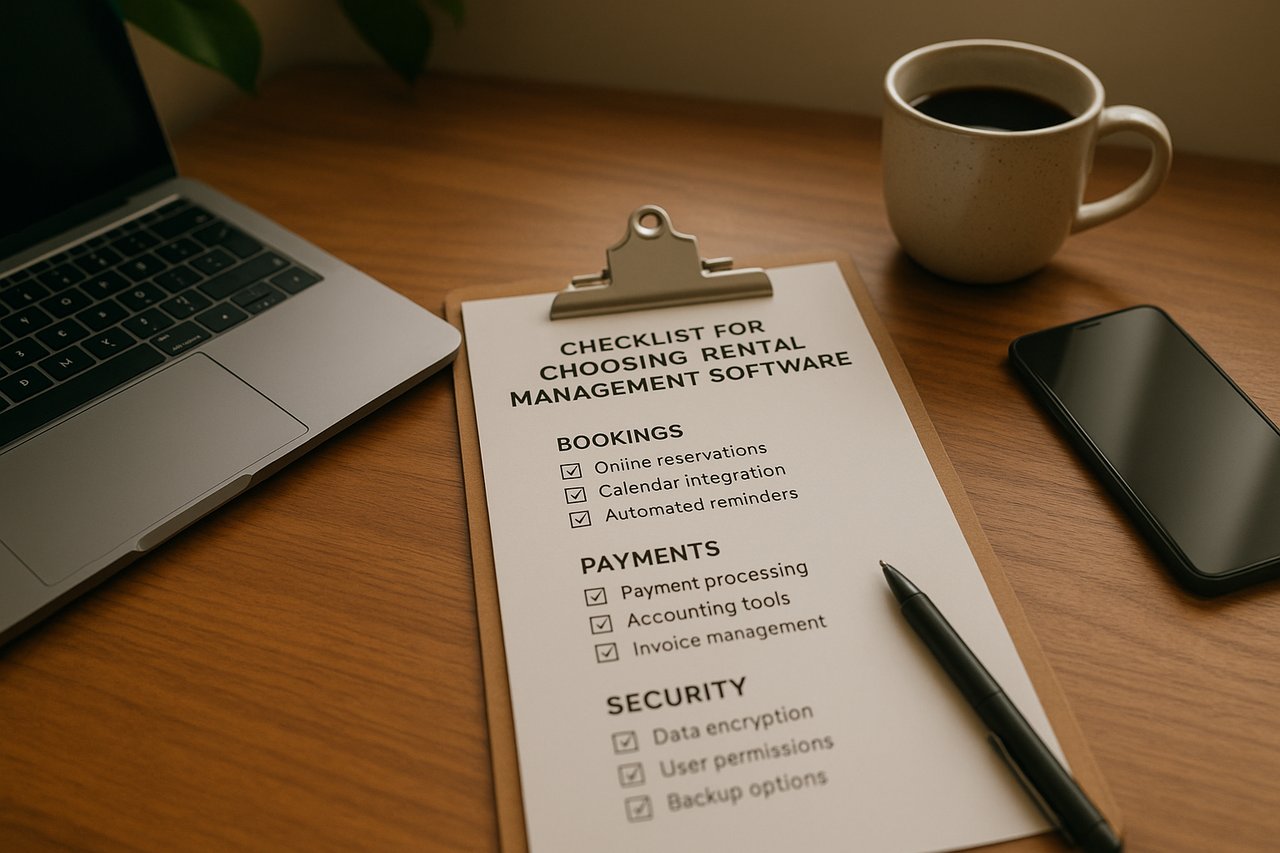
Checklist for Choosing Rental Management Software
Managing rental properties becomes challenging as your portfolio grows. Rental management software simplifies operations, saves time, and boosts profitability by centralizing tasks like booking management, guest communication, financial reporting, and maintenance tracking. Choosing the right platform ensures efficiency, while the wrong choice can create costly disruptions.
Key Features to Look For:
-
Booking Management: Real-time calendar syncing, dynamic pricing, and automated guest communication.
-
Maintenance & Housekeeping: Task automation, vendor tracking, and expense management.
-
Financial Tools: Automated payments, expense categorization, and tax-ready reports.
-
Integration: Compatibility with platforms like Airbnb and accounting tools like QuickBooks.
-
Scalability: User-friendly interfaces that grow with your portfolio.
-
Security: Encryption, multi-factor authentication, and compliance with regulations.
-
Support: Accessible customer service and training resources.
Pricing Considerations:
-
Models: Per-unit, flat-rate, or tiered subscriptions.
-
Hidden Costs: Transaction fees, add-ons, and integration charges.
-
Free Trials: Test software to ensure ROI through time savings and reduced errors.
The best software aligns with your needs, scales with your growth, and improves tenant satisfaction. Evaluate features, test usability, and consider pricing to choose a solution that simplifies property management and supports long-term success.
Best Property Management Software: Our Top 5 Recommendations
1. Core Features to Look For
When choosing rental management software, it should simplify your daily operations, not complicate them. Focus on features that enhance how you manage bookings, interact with guests, and keep your properties in top condition.
Reservation and Booking Management
Your software must prevent double bookings by synchronizing calendars in real time. If a guest books on one platform, that date should instantly be blocked on all others.
Look for platforms that allow you to customize booking rules to fit your specific needs. The system should effortlessly handle transactions and track reservations from the first inquiry to final checkout. Automated confirmations and reminders for upcoming check-ins are essential for keeping everything on track.
For property managers juggling multiple units, a unified dashboard displaying all reservations across your portfolio can save hours of hassle.
Dynamic pricing is another must-have. Your software should adjust rates automatically based on demand, local events, or seasonal trends, without requiring you to constantly make manual updates.
And don’t forget guest communication tools - they’re key to creating a smooth experience for everyone.
Guest Communication Tools
Managing guest communication can get messy if you're switching between platforms. A centralized messaging system keeps everything in one place, combining emails, texts, and in-app messages. This gives you a complete conversation history with each guest, making it easier to stay organized.
Automated messaging is a game changer. Routine communications like pre-arrival instructions, check-in details (including access codes or lockbox info), and post-checkout surveys can all be scheduled to send automatically. This not only saves time but also ensures a consistent and professional experience for your guests.
Customizable templates are another helpful feature. These let you quickly respond to common questions and set up automated replies during off-hours, so guests receive immediate acknowledgment even when you're unavailable.
Keeping a detailed communication history for each guest and property helps resolve issues faster and provides a clear record of interactions.
Housekeeping and Maintenance Tracking
Keeping your properties in top shape requires efficient maintenance tools. Your software should handle maintenance requests, task assignments, and progress tracking on both mobile and desktop platforms.
Automating cleaning schedules is a big plus. The system should schedule cleanings between guest checkouts and check-ins, assign tasks to the right staff or vendors, and send notifications when jobs are completed. This eliminates manual coordination and reduces the risk of missed cleanings or scheduling conflicts.
A vendor database is another handy feature. It lets you store contact details and service histories for your preferred contractors, so you can quickly find the right person for the job and review past work.
Expense tracking for maintenance and cleaning costs is essential for managing your budget. The software should categorize expenses by property and type, helping you identify where costs are higher and where savings might be possible. Attaching photos or documents to work orders also provides a clear record for insurance claims or owner reports.
Finally, mobile notifications ensure you’re alerted to urgent repairs immediately, so critical issues get resolved without delay.
2. Multi-Channel Integration
Keeping your calendars in sync across all platforms is essential to avoid double bookings and ensure accurate availability. The right software can make this process seamless.
Platform Compatibility
When choosing rental management software, make sure it works with major short-term rental platforms like Airbnb, Vrbo, and Booking.com. This integration saves you from the hassle of manual updates and ensures all your bookings are consolidated in one central calendar. It’s even better if the software offers real-time syncing, so every reservation is updated instantly.
Real-Time Updates
Real-time updates are a game-changer for avoiding double bookings. The moment a guest reserves your property on one platform, the software should automatically update availability across all other channels. This instant synchronization keeps your booking process smooth and stress-free. Additionally, having strong direct booking tools in place can give you even more control over your reservations.
Direct Booking Options
Look for software that includes a customizable direct booking engine. This allows guests to book directly through your website while automatically updating your central calendar. When your direct booking system seamlessly integrates with your channel management tools, every reservation - no matter where it comes from - is accounted for in one place.
3. Financial Management and Reporting
Managing the financial side of your short-term rental business doesn’t have to feel overwhelming. With the right tools, you can automate payment collection, track expenses, and generate essential reports - all without needing a background in accounting.
Payment and Expense Automation
Automating payments can save you hours each week. Look for software that handles guest payments via ACH or credit card automatically and deposits the funds securely into your account. This process reduces the risk of missed payments and eliminates the need for constant follow-ups.
Expense tracking can be just as seamless. Many platforms connect directly to your bank accounts, pulling in transactions automatically through bank feeds. These tools can categorize expenses - like cleaning fees, maintenance costs, or utilities - so you always have a clear picture of where your money is going.
Some platforms offer tiered pricing based on these features. For example, TurboTenant’s Premium plan costs $119 annually and waives ACH fees for tenants, helping lower your payment processing costs. On the other hand, Stessa’s PRO plan, priced at about $28 per month, includes automated bank feeds, recurring expense tracking, and access for up to three team members.
Once payments and expenses are automated, the next step is leveraging detailed financial reporting.
Financial Reporting
Comprehensive financial reporting turns your rental data into useful insights. Choose software with customizable dashboards that provide a quick overview of your income, expenses, and cash flow. If you manage properties for other investors or have partners, the ability to create owner statements is especially helpful.
Tax season becomes less stressful with automated tax reports. Features like income statements, categorized expense summaries, and year-end summaries ensure you’re ready to hand over a complete financial snapshot to your accountant - no more digging through bank statements and receipts.
Different platforms vary in their reporting capabilities. For instance, Yardi Breeze’s Premier plan starts at $2 per unit per month (with a $400 monthly minimum) and includes advanced reporting options. For smaller portfolios, DoorLoop offers pricing tiers - Starter at $59 per month for up to 20 units, Pro at $99, and Premium at $139 per month. Each tier provides increasingly detailed reporting features.
The key is to choose reporting tools that match your needs. If you manage just a few properties, basic income and expense reports might suffice. However, larger portfolios or properties with multiple owners often require more advanced tracking and customizable reports. Automated, clear financial reports help you make informed decisions and improve operational efficiency.
Accounting Software Integration
Integrating your rental management software with accounting tools like QuickBooks can further simplify your financial processes. This connection eliminates the need for duplicate data entry and minimizes errors. Payments and expenses flow directly into your accounting software, keeping everything synced without manual input.
As your portfolio grows, this integration becomes even more valuable. Instead of spending hours reconciling accounts across different platforms, automation ensures your financial data stays accurate and consistent. Your books remain balanced, and you spend less time on tedious administrative work.
When selecting software, confirm compatibility with your preferred accounting tools. Some platforms offer direct integrations, while others may require third-party connectors or manual exports. The smoother the integration, the easier it is to manage your finances.
For property owners looking to streamline their financial management, this integration is a game-changer. Combining automated payments, detailed reporting, and accounting tool integration creates a system that practically runs itself - allowing you to focus on scaling your rental business.
4. User Experience and Scalability
A well-designed interface and the ability to scale are essential for software to remain effective both now and as your business grows. Opting for software that's user-friendly today but also capable of handling future demands can save you the hassle and expense of switching platforms later.
Ease of Use
A cluttered interface can turn even simple tasks into a chore. When assessing software, prioritize platforms with clean, intuitive dashboards that keep your most-used features front and center. Essential tools should be no more than a few clicks away.
Take TurboTenant, for example. It combines rental listings, online rent collection, tenant screening, maintenance requests, and accounting tools into one easy-to-navigate dashboard. This design ensures you spend less time searching for features and more time managing your properties effectively.
The learning curve matters, especially when onboarding new team members. Software with straightforward navigation, familiar terminology, and helpful tooltips makes it easier for users to get up to speed. Testing the software with common tasks can help confirm its usability.
Rentec Direct is a good example of simplicity in action, offering core financial and operational tools without unnecessary complexity.
Once you've established that the software is intuitive, the next step is ensuring it can handle your growing needs.
Scalability
User-friendly software should also be capable of adapting to your expanding portfolio. What works well for a small set of properties may not be sufficient for managing dozens or even hundreds. Start by checking the platform's technical capacity. For instance, Buildium supports portfolios ranging from small residential properties to thousands of units, offering a robust set of tools that can grow with your business.
Pricing is another critical factor. Look for a model that provides predictable costs as your portfolio expands. Flat-rate pricing can prevent unexpected expenses tied to growth.
As your business grows, team collaboration becomes increasingly important. Ensure the software allows multiple users without dramatically increasing costs. For example, Landlord Studio’s PRO plan supports up to 3 users for about $28 per month, while the PRO Plus plan accommodates up to 10 users and includes unlimited document storage.
It's also worth asking vendors about their largest clients and requesting references from property managers with similar growth trajectories. Their feedback can give you a clearer picture of the platform's scalability and potential limitations.
Mobile Accessibility
Being able to manage your properties on the go isn’t just convenient - it’s often essential. Whether you're traveling, meeting with tenants, or handling an emergency repair, mobile access ensures your business stays on track.
Native mobile apps generally provide better functionality than mobile-optimized websites. RentRedi, for instance, is built as a mobile-first platform, making rental management seamless for landlords of any portfolio size. Test the app during a trial period to ensure key features like payment approvals, maintenance requests, and financial dashboards work smoothly on your device.
Offline functionality is another must-have. Basic tasks like checking property details or reviewing maintenance history should be accessible even without an internet connection, with updates syncing once you're back online.
Lastly, security is critical. Look for apps with biometric login options like fingerprint or face recognition. This feature not only saves time but also keeps sensitive tenant and financial data secure without requiring you to re-enter passwords repeatedly throughout the day.
5. Security and Compliance
Managing rental properties involves handling sensitive data - guest payment details, personal IDs, and financial records. A security breach can not only tarnish your reputation but also expose you to legal risks. That’s why understanding the security and compliance features of rental management software is absolutely essential before making a choice.
Data Privacy and Security
The software you choose should meet industry-standard security protocols. Look for features like SSL/TLS encryption for data in transit, AES-256 encryption for stored data, and SOC 2 Type II certification. These ensure that sensitive information is protected at every step. Additionally, compliance with regulations like GDPR, CCPA, and relevant state laws is non-negotiable.
Multi-factor authentication (MFA) is a must-have. This feature requires users to verify their identity with a second method - like a text code or an authenticator app - alongside their password. It significantly reduces the chances of unauthorized access.
As your team grows, role-based access control becomes crucial. For instance, your maintenance staff doesn’t need access to financial records, and your accountant doesn’t need to see guest communications. The software should allow you to assign different permissions to different users, ensuring everyone only accesses what they need.
The reality is stark: 60% of small businesses face data breaches annually. Rental management platforms handle exactly the type of sensitive information that cybercriminals target, making robust security measures a necessity, not a luxury.
Payment Security
Handling payments securely is just as critical as protecting other data. Any software that processes credit card transactions must adhere to PCI DSS Level 1 certification, the gold standard in payment security. Non-compliance can lead to fines of up to $100,000 per month.
To minimize risk, choose software that partners with reputable payment processors like Stripe, PayPal, or Square. These processors handle sensitive transaction data, so the software itself doesn’t store complete credit card numbers.
Tokenization adds an extra layer of security by replacing sensitive payment data with unique tokens. Even if a breach occurs, the stolen tokens are useless without the decryption key, which is securely held by the payment processor.
Offering multiple payment options, such as ACH transfers, can also reduce fraud risks. ACH transactions tend to have lower fraud rates compared to credit cards and often come with lower processing fees. When evaluating software, ask for their PCI DSS compliance documentation. Reliable providers will be transparent and explain how they conduct regular penetration testing to identify and fix vulnerabilities.
Backup and Disaster Recovery
Data loss can happen due to hardware failures, server crashes, or even natural disasters. Without a solid backup plan, you risk losing vital data like booking histories, financial records, and guest information. That’s why backup and disaster recovery features should be a top priority.
The software should offer automated daily backups with redundant storage across geographically separated data centers. This ensures that if one data center is compromised, your data remains safe elsewhere.
Ask providers about their Recovery Time Objective (RTO) and Recovery Point Objective (RPO). RTO tells you how quickly they can restore services after a failure, while RPO indicates how much data you might lose. Aim for an RTO of under 4 hours and an RPO of no more than 1 hour.
Another key factor is disaster recovery testing. Serious providers conduct regular tests - quarterly or semi-annually - to ensure their recovery processes work when needed. Request their latest test results to see how they perform under pressure.
Automatic failover capabilities are also a plus. If the primary system fails, the software should seamlessly switch to backup servers without manual intervention, keeping your operations running without interruption.
Finally, ensure the software allows you to export your data in standard formats like CSV or JSON. This flexibility ensures you’re never locked into a platform. Whether you’re switching providers or sharing data with your accountant, exporting your information should be hassle-free.
6. Support and Training Resources
Even the best software is only as good as the support behind it. When you're managing properties, technical hiccups are bound to happen - whether it’s setting up your first property or dealing with payment processing issues. That’s why having reliable support and clear training resources is key to keeping things running smoothly.
Customer Support Availability
Property management challenges don’t stick to a 9-to-5 schedule. That’s why access to responsive support is so important. Essential support options include live chat for quick fixes, phone support for more complicated problems, and email for issues that aren’t urgent.
For instance, Buildium is known for providing timely support, which is invaluable when juggling multiple properties. Pricing often correlates with the level of support offered. DoorLoop, for example, includes a dedicated account manager with its Premium plan at $139/month, while its Starter plan at $59/month leans more on self-service tools.
The type of support you need depends on your portfolio size and how comfortable you are troubleshooting on your own. If you’re managing a small portfolio of 1–10 properties, detailed documentation and an active user community might be enough. But for larger portfolios or if you prefer hands-on help, investing in a higher-tier support plan could save you a lot of time and headaches.
Having clear, accessible support options is a game-changer for onboarding and long-term software use.
Training and Onboarding
A solid onboarding process can make all the difference when adopting new software. The best platforms offer a mix of comprehensive guides, video tutorials, live training sessions, and role-specific instructions to get you up to speed.
Some platforms are designed to be intuitive, requiring minimal onboarding, while others - especially those geared toward larger enterprises - might require more in-depth training. Look for platforms that offer live webinars, extensive documentation, and even dedicated onboarding specialists if you’re managing a larger portfolio.
For smaller portfolios (1–10 properties), platforms with user-friendly interfaces and good self-service tools are usually enough. Larger portfolios or more complex systems might require dedicated training support. Typically, user-friendly systems need only about 2–5 hours of training, while more advanced ones could take anywhere from 20–40 hours to fully master. Video tutorials should cover everything from the basics to advanced features, with clear timestamps to help you find what you need quickly. A well-organized knowledge base can also be a lifesaver, helping you troubleshoot issues without needing to contact support.
On top of formal training, tapping into peer support through active user communities can further enhance your learning curve.
User Community and Forums
User communities and forums are goldmines for peer-to-peer assistance. They’re places where landlords can swap tips, troubleshoot common problems, and share lessons learned. An active community often signals a thriving software ecosystem - chances are, someone has already faced and solved the issue you’re dealing with.
When evaluating a platform, check to see if it has active forums, user groups, or dedicated communication channels. A steady stream of recent posts and ongoing discussions is a good sign that the community is engaged and ready to help. These forums often reveal practical tips - like automation shortcuts or integration hacks - that you won’t find in the official guides.
The best approach blends strong self-service resources with responsive expert support. By exploring documentation, participating in community forums, and testing support channels, you can ensure the software you choose fits your needs and helps you manage your properties efficiently.
7. Pricing and Cost Analysis
Analyzing costs is just as important as evaluating features when choosing rental management software. The key is to match the software's pricing structure with your current portfolio size and growth plans to maximize efficiency and save time.
Pricing Models
Rental management software typically follows one of three pricing models. Each has its own advantages, depending on your specific needs.
-
Per-unit pricing adjusts based on the size of your portfolio. For example, Yardi Breeze charges $1 per unit per month with a $100 minimum for basic features, or $2 per unit per month with a $400 minimum for advanced features. This model is ideal for smaller portfolios but can become costly as your portfolio grows.
-
Flat-rate pricing offers a fixed monthly fee, regardless of the number of properties you manage. RentRedi, for instance, provides unlimited properties, tenants, and team members for a single monthly rate. This approach simplifies budgeting and avoids the cost increases associated with portfolio expansion. If you're planning to grow from 10 to 50 units, flat-rate pricing can offer better long-term value.
-
Tiered subscription pricing lets you choose from different feature levels at varying price points. Platforms like TurboTenant and DoorLoop offer free tiers with basic features and paid tiers for more advanced tools. This allows you to start small and upgrade as your needs evolve.
For landlords managing smaller portfolios or just starting out, free options are available. TenantCloud’s free Starter plan covers up to 75 units with basic features, while Stessa offers a free plan with unlimited properties, income and expense tracking, online rent collection, and basic reporting. These free plans eliminate upfront costs and let you test the platform before committing to a paid plan.
When comparing pricing models, it’s important to calculate your total cost of ownership. For example, managing 15 units at $2 per unit would cost $30/month now, but as your portfolio grows to 40 units, the cost would rise to $80/month. A flat-rate plan at $60/month offers more predictability and could save you money in the long run.
Beyond the base fees, be mindful of additional charges to get a clear picture of total costs.
Hidden Costs
The advertised price is often just the starting point. Hidden fees can quickly add up, so identifying these costs upfront can save you from budget surprises.
-
Transaction fees are among the most common extra charges. Some platforms pass these fees on to tenants for online rent payments, which might create friction or reduce your collection rate. Clarify who absorbs these fees - tenants, you, or the software provider.
-
Add-on features like accounting tools, tenant screening, or maintenance management may require extra payments or higher-tier subscriptions. For example, essential tools like financial reporting might only be available in premium plans. Always ask for a detailed breakdown of fees for features you plan to use.
-
Per-user costs can increase expenses as your team grows. Stessa’s PRO Plus plan, priced at about $28/month, supports up to 10 users, while the standard PRO plan limits access to three users. Similarly, Landlord Studio’s PRO plan allows three users, but the PRO Plus plan expands this to 10 users with unlimited document storage. If you’re planning to hire additional staff, factor in these user-related charges.
-
Integration fees may apply when connecting third-party tools like accounting software or payment processors. For example, DoorLoop’s Premium plan at $139/month includes open API access and dedicated account managers - features that may be unnecessary for individual landlords but essential for professional firms. Additionally, enterprise platforms like AppFolio often include setup and implementation fees for larger operations.
Also, check whether essential tools like e-signatures or lease customization are included in the base plan or require separate purchases. For instance, TenantCloud’s Pro plan at $47/month connects landlords with pre-vetted contractors, a feature not available in lower tiers.
Once you’ve accounted for all costs, test the software to ensure it delivers value for your investment.
Free Trials and ROI
Most platforms offer free trials or freemium models, allowing you to test their features before making a financial commitment. Use these trials to determine whether the software justifies its cost by providing measurable returns.
The return on investment (ROI) for property management software largely depends on your portfolio size, current operations, and how you use the platform. One of the biggest benefits is time savings. By automating tasks like tenant screening, rent collection, maintenance coordination, and financial reporting, software can save 10-20 hours of administrative work per month for larger portfolios. With property managers earning $25-$40 per hour on average, this translates to $250-$800 in monthly labor savings.
Improved rent collection efficiency is another key benefit. Platforms like Buildium and AppFolio automate reminders and ACH processing, reducing delays and late payments. Even small improvements in on-time payments can significantly boost cash flow.
Lower vacancy rates are achievable through faster tenant acquisition, thanks to features like syndicated listings and streamlined application processes. A 2-3% reduction in vacancy on a $50,000 annual rental income portfolio could save $1,000-$1,500 per year. Additionally, better maintenance tracking can reduce emergency service calls by 15-25%.
To estimate ROI, calculate your monthly labor savings, improved rent collection, and reduced vacancy losses, then subtract the annual software cost. For example, a landlord managing 10-20 units and spending $120-$300 annually on software often sees ROI within 2-4 months. Larger portfolios with 50+ units typically achieve ROI in just 1-2 months due to greater operational complexity and time savings.
During the trial period, focus on features that address your biggest operational challenges, such as expense tracking or automated messaging. Compare how long these tasks take manually versus using the software. This will give you concrete data to assess ROI.
Ultimately, the value of property management software goes beyond its price. A platform that costs $100/month but saves you 8 hours of work effectively pays for itself if your time is worth more than $12.50 per hour. For most landlords, the time saved can be reinvested into growing their portfolio or other income-generating activities.
Accurately evaluating pricing ensures your software choice supports efficient property management.
Conclusion
Selecting the right rental management software comes down to aligning its features with your specific needs and the size of your property portfolio. The ideal platform should streamline repetitive tasks, minimize errors, and enhance tenant communication.
Start by identifying your biggest pain points. Look for software that simplifies payment collection and tracks maintenance requests seamlessly. For smaller portfolios - typically 1 to 10 units - options like TurboTenant, Stessa's free tier, or Baselane offer essential tools at a minimal cost.
Scalability is just as important as current functionality. Consider whether a per-unit pricing model or a flat-rate structure better fits your growth plans. If you're managing 50 or more units, you’ll likely need advanced features such as customizable dashboards, detailed reporting, and API integrations. Once you've narrowed down options based on scalability and budget, test how well the software performs in real-world scenarios.
Take advantage of free trials to evaluate how much time the platform saves compared to manual processes. For instance, if the software frees up 10 hours a month, you can redirect that time toward expanding your portfolio or improving tenant relationships.
A great platform should also improve tenant satisfaction. Features like easy payment methods, responsive maintenance tracking, and clear communication tools make a big difference. Happy tenants are more likely to pay on time, renew leases, and require less hands-on management.
Don’t overlook the total cost of ownership, including potential hidden fees or per-user charges. Even a platform that costs $100 per month can be a worthwhile investment if it allows you to manage more properties without hiring extra staff or significantly reduces labor hours.
Involve your team in the decision-making process. They can often spot inefficiencies or underused features that might not be obvious initially. Since software features and pricing can change over time, make it a habit to reassess your platform regularly to ensure it continues to meet your evolving needs.
By focusing on essential features, ease of integration, robust financial tools, user-friendliness, and strong security, you can find software that simplifies your daily operations and grows alongside your business. Take the time to research, test, and choose a solution that not only meets your current needs but also supports your long-term goals.
For more guidance on aligning software with your property management strategy, check out Shawn Gerald at https://shawngerald.com.
FAQs
What key features should I look for in rental management software to efficiently manage a growing property portfolio?
When selecting rental management software for a growing portfolio, focus on features that simplify tasks and improve productivity. Key functionalities to look for include automated booking management, calendar synchronization across multiple platforms, and payment processing that supports U.S. dollars ($). Having strong reporting and analytics tools is also a must, as they help you monitor performance and make informed decisions based on data.
It's also worth prioritizing software with tenant communication tools, maintenance tracking, and dynamic pricing options to maximize revenue potential. Scalability is another critical factor - make sure the software can grow with your portfolio without losing efficiency. By choosing a platform with these capabilities, you'll be in a much better position to manage your properties efficiently and free up valuable time.
How does rental management software enhance tenant satisfaction and streamline communication?
Rental management software enhances the tenant experience by streamlining communication and addressing concerns more efficiently. Tenants can quickly submit maintenance requests, monitor progress, and get timely updates, making the whole process much smoother. Many platforms also send automated reminders for rent payments and lease renewals, helping to minimize confusion and avoid late fees.
On top of that, these tools often offer secure online payment options and easy access to key documents like lease agreements. This added convenience and clarity make life simpler for tenants. By ensuring open and efficient communication, property owners can foster stronger tenant relationships and boost overall satisfaction.
What should I know about hidden costs and pricing structures when selecting rental management software?
When choosing rental management software, don't just focus on the advertised price - it’s often only part of the story. Many platforms come with hidden expenses, like charges for extra users, access to premium features, or transaction processing fees. Make sure to inquire about setup costs, subscription levels, and whether you'll face additional fees for integrations or customer support.
It’s also important to understand how the pricing works. Some platforms charge a flat monthly rate, while others base their fees on the number of properties you manage or take a percentage of your bookings. Take the time to go through the terms carefully to ensure the pricing structure fits both your budget and your business goals.